
About warehouse steel buildings
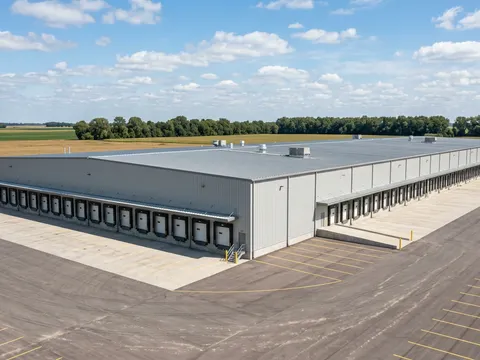
Warehouse and distribution buildings require a balance of size, strength, and functionality. Our steel warehouse structures are engineered for high-bay clear spans, multiple loading positions, and the floor loads and column spacing that modern logistics demand.
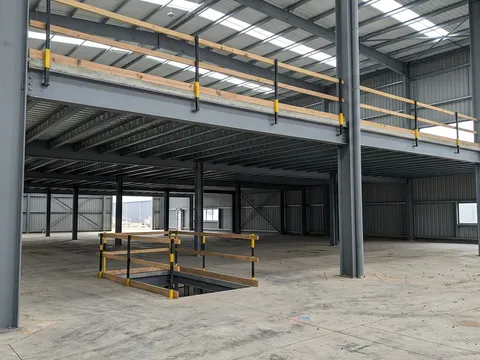
We work with distributors, manufacturers, and 3PL operators to design warehouses that maximize cubic footage and workflow. Options include insulated panels for climate control, mezzanine framing, and office buildouts.
Warehouse Projects
Across Canada
Who Uses Steel Warehouse Buildings
Steel warehouses serve a wide range of industries across Canada. The clear-span interior, configurable loading positions, and fast erection timeline make them the standard choice for any operation that needs large, durable, and cost-effective enclosed space.
Distribution & Third-Party Logistics
Regional distribution centres, e-commerce fulfilment, and 3PL operators require maximum cubic footage, high clear heights for racking, and multiple loading dock positions. Our clear-span frames from 100–200'+ eliminate interior columns that would otherwise obstruct racking aisles and forklift paths.
Manufacturing & Production Storage
Raw material staging, finished goods storage, and work-in-progress areas adjacent to production lines all benefit from a column-free floor plan and reinforced slabs designed for heavy point loads and aisle equipment.
Cold & Temperature-Controlled Storage
Insulated metal panel (IMP) wall systems with thermal breaks allow continuous cold-chain or controlled-atmosphere warehousing for food, pharmaceutical, agricultural, and chemical products.
Cross-Docking & Transload Facilities
High-throughput cross-docking requires dock doors on two opposing walls, wide clear spans for staging lanes, and hard floors designed for continuous forklift traffic. We engineer dock counts, dock heights, and aisle widths into the structural layout from day one.
Agricultural Commodity Storage
Grain receiving stations, fertilizer warehouses, and bulk commodity storage operate in corrosive environments that demand galvanized framing, sealed concrete, and ventilation systems. Our agricultural-grade coatings and engineering handle these conditions.
Commercial Self-Storage
Multi-unit self-storage and mini-storage facilities use our steel framing with light-gauge interior partitions, roll-up doors, and optional climate-controlled corridors to maximize rentable square footage and ROI.
Built for
Performance
Large Clear-Span
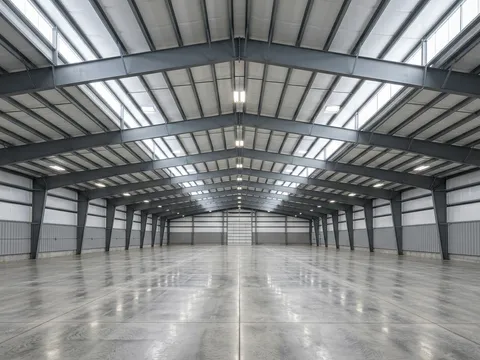
Column-free interiors from 60' to 200'+ wide for forklifts, racking, and flow.
Dock & Door Options
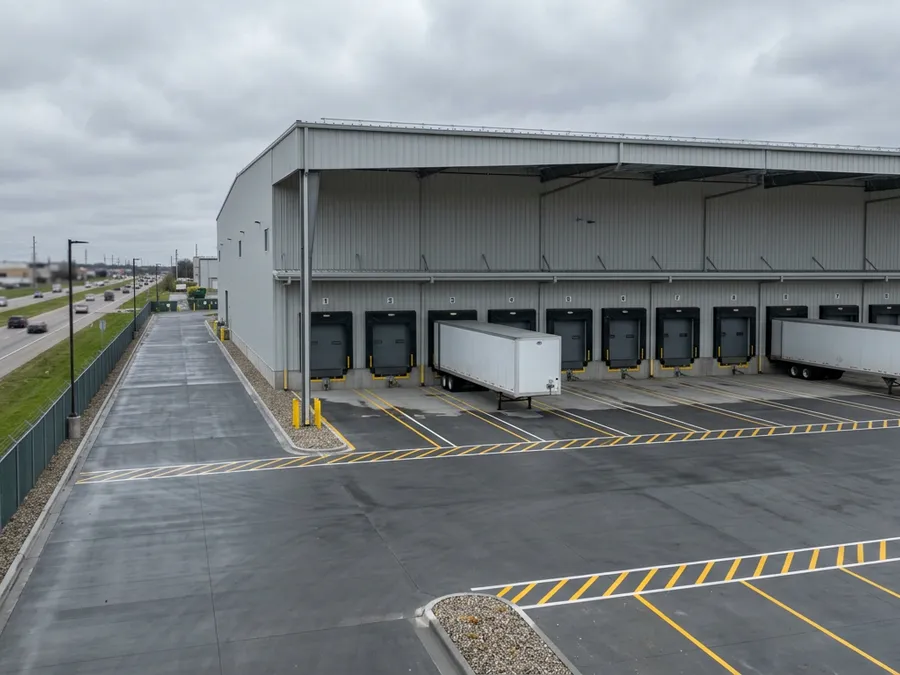
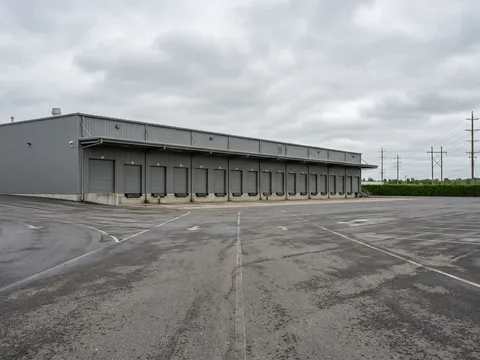
Multiple loading docks, drive-through doors, and dock levelers to suit logistics.
Heavy Floor Loads
Engineered for pallet racking, mezzanines, and equipment with reinforced slabs.
Technical
Details & Sizes
Every warehouse building is custom-engineered. The ranges below represent what we typically build. Your project is designed to your exact site, code, and program.
Common configurations
60–80' wide × 18–24' eave. Suits 1–3 dock doors and single-aisle racking up to 20'.
100–120' wide × 24–30' eave. Accommodates 4–8 docks, double-deep racking, and a mezzanine office.
150–180' wide × 30–36' eave. High-bay racking to 30', VNA forklift aisles, and 10–24 dock doors.
180–200'+ wide × 36–40'+ eave. Suited for automated storage and retrieval systems (ASRS), bulk rack, and large-volume commodity storage.
Rack-ready: 24–28'. High-bay: 32–40'. Design clear height equals eave height minus haunch depth.
25' bays are most common for standard selective racking. 30' bays allow wider aisles or double-deep racks without column conflicts.
Warehouse Options and Accessories
Every warehouse is custom-quoted. The following options are commonly included at the design stage. Pricing is more accurate and construction is faster when they are engineered in from the start rather than added later.
Insulation and Climate Control
- Batt-and-liner insulation: R-13 wall / R-19 roof (unheated storage)
- Batt-and-liner insulation: R-20 wall / R-30 roof (heated warehouse)
- Insulated metal panels (IMP): R-13 to R-38 continuous, thermal-bridge-free
- Vapour barrier systems for heated or cold-storage applications
- HVAC rough-in provisions (sleeves, curbs, structural support)
Loading Docks and Overhead Doors
- Standard dock door opening: 9'W × 10'H or 10'W × 10'H
- Sectional steel overhead doors: manual or electric operation
- Hydraulic dock levelers: 6' × 8' or 6' × 10' platforms
- Dock seals and shelters for environmental control
- Dock bumpers and impact guards
- Grade-level drive-in doors: 14'W × 14'H or larger
- Drive-through configuration (doors on opposing end walls)
Foundation and Slab
- Anchor bolt plans sealed to NBC 2020 and provincial code
- Slab-on-grade: 6''–8'' reinforced for forklift and racking loads
- Slab joint layout for heavy point loads (rack legs and column bases)
- Dock pit construction provisions
- Site drainage and exterior apron design
Interior Structures
- Structural mezzanine framing for offices or pick-and-pack areas
- Overhead crane rails and runway beams (5–30 ton capacity)
- Monorail hoist provisions
- Interior liner panels and partitions
- Skylights and translucent roof panels for natural daylighting
Exterior and Roofing
- Standing-seam or through-fastened Galvalume® roofing
- Gutters, downspouts, and overflow scuppers
- Ridge ventilation and powered exhaust fans
- Exterior LED canopy lighting provisions over dock aprons
- Painted wall panel systems in standard or custom colors
Engineering and Permitting Process
Pre-engineered steel warehouses must meet the National Building Code of Canada (NBC 2020) and the applicable provincial building code. We manage every step of the engineering and permitting process.
We confirm your site address, zoning classification, setback requirements, and any municipal overlay restrictions that affect building size, height, or loading dock orientation.
Our team prepares a layout plan showing structural bay spacing, loading dock positions, door locations, and eave height. This plan drives the structural design and forms the basis of your quote.
A licensed structural engineer performs site-specific load analysis: ground snow load from NBC 2020 climatic data, wind exposure category, seismic zone, and live load for your equipment. Stamped drawings are produced for the primary steel frame, secondary framing, and anchorage.
We prepare and submit the permit package to your municipality, including site plan, architectural drawings, structural drawings, and engineer's letter of certification. We respond directly to building department review comments.
Primary steel frames are fabricated at our mill to the approved structural drawings. Fabrication begins at deposit and runs concurrently with the permit review in most municipalities, minimizing schedule overlap.
Your contractor pours the anchor bolt foundation to our sealed anchor bolt plan. We provide bolt templates and inspection checkpoints to ensure the foundation is ready to receive steel.
Steel is delivered to site and erected by our erection crew or your nominated contractor using our erection drawings. Roofing, wall panels, doors, and accessories are installed in sequence.
What Drives Warehouse Building Costs
Steel warehouse pricing is influenced by several independent variables. Understanding these helps you make design decisions early that keep the project within budget.
The primary cost driver. Larger buildings benefit from economies of scale; cost per square foot generally decreases as total area increases beyond 20,000 sq ft.
Wider clear spans require heavier primary frames. Buildings wider than 150' carry a meaningful premium per square foot versus 80–120' widths. Narrower multi-span designs can reduce frame cost at the expense of some interior flexibility.
Each additional 4' of eave height adds roughly 3–6% to primary frame cost and increases wall panel area. High-bay designs (30'+ eave) carry a 10–20% frame premium over standard-height buildings.
Each dock door, leveler, seal, and pit adds a fixed cost per position. High dock counts require longer wall sections, larger apron areas, and additional structural headers.
Unheated storage (R-13) is the lowest cost option. Heated warehouse (R-20–R-30) adds 15–30% to wall and roof costs. Cold storage using IMPs adds 40–70% over uninsulated construction.
Steel is priced in Canadian dollars and fluctuates with commodity markets. Remote site delivery adds trucking cost. Projects more than 500 km from the fabrication plant may carry a delivery premium.
Slab-on-grade on firm soil is the baseline. Soft soils, rock, high water tables, or frost-depth requirements that exceed local norms can significantly increase foundation cost. We provide anchor bolt plans; foundation construction is owner-supplied.
Skylights, mezzanines, crane rails, interior liners, and custom paint colors each add incremental cost but rarely change the overall project budget by more than 5–15% individually.
Frequently Asked Questions About Warehouse Steel Buildings
How large can a steel warehouse be?
Our steel warehouses can be built from 10,000 sq ft up to 200,000+ sq ft and beyond. Clear-span widths up to 200′ eliminate interior columns for unobstructed racking and forklift operation. Length is effectively unlimited through bay additions. Just tell us your target square footage and ceiling height.
Are steel warehouses insulated for temperature control?
Yes. We offer insulated metal panel (IMP) wall systems and batt-and-liner insulation packages rated from R-13 to R-40+. For cold-storage applications we use continuous IMPs with thermal breaks. All insulation systems include vapor barriers rated for Canadian climates.
Can a steel warehouse support mezzanine levels?
Yes. Mezzanine framing, intermediate floors for offices or pick-and-pack areas, and structural provisions for overhead cranes or monorails can all be integrated at the design stage. Adding mezzanine capacity after the fact is also possible with proper engineering.
Can I add loading docks to a steel warehouse?
Yes. Loading dock count, size, dock height, hydraulic dock levelers, and dock seals are all engineered into the building design from the start. We also accommodate drive-through doors, grade-level overhead doors, and man doors in any configuration.
How quickly can a steel warehouse be built?
Pre-engineered steel components dramatically shorten site construction time. A 20,000 sq ft warehouse typically erects in 4–8 weeks once the foundation is ready, versus 4–6 months for conventional construction. Lead time from order to delivery is usually 8–14 weeks depending on size and specifications.
Ready to Build Your
Warehouse Building?
Get a free consultation and custom quote for your site, program, and building code requirements.


